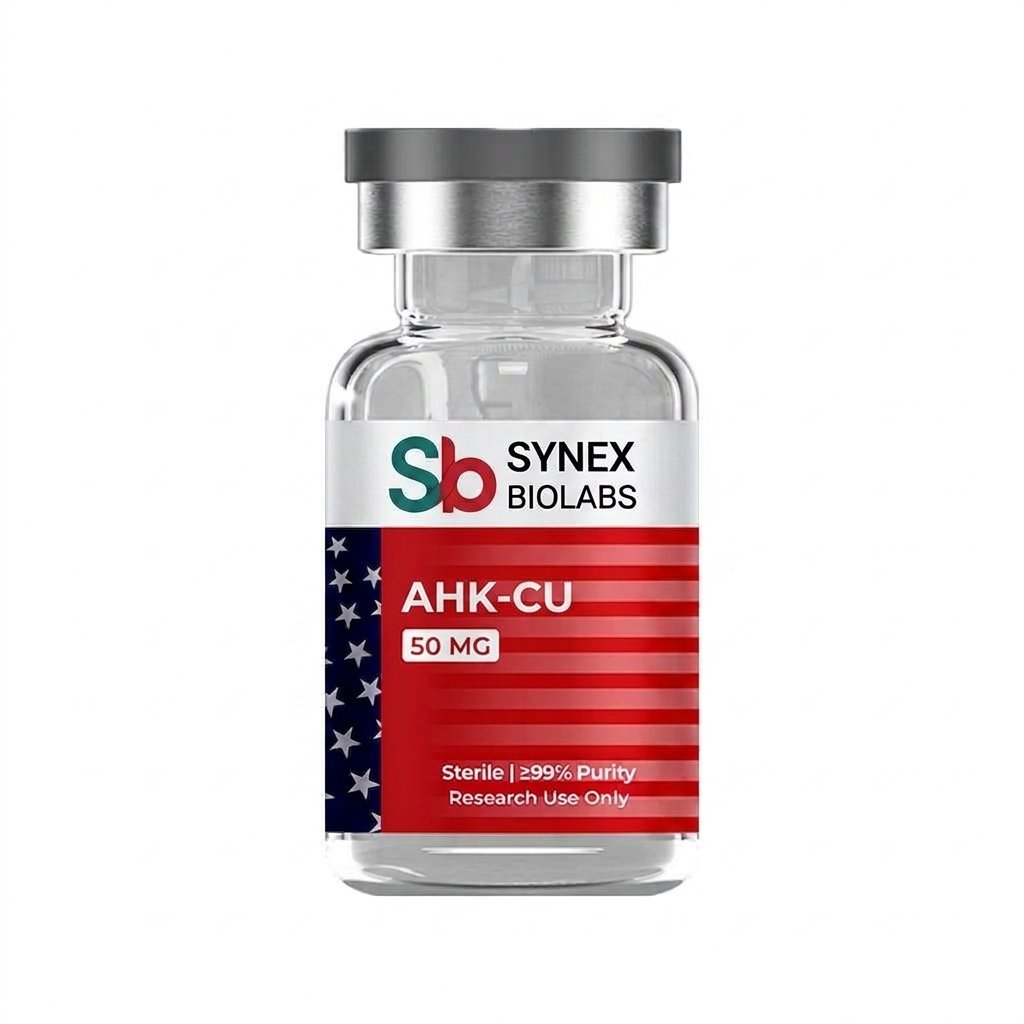
AHK-Cu Research Peptide
For research use only. Not for human or veterinary consumption. Not a drug, supplement, cosmetic, or food.
AHK-Cu is a synthetic copper-complexed tripeptide made of alanine, histidine, and lysine, and it is used in laboratory research on copper-peptide chemistry, metal-binding, and cell-signaling models. Synex Bio Labs supplies AHK-Cu as a lyophilized research peptide for in-vitro and laboratory use, with documentation so that researchers can verify identity and purity before starting work. This page explains what AHK-Cu is, how it is studied, what quality documentation to expect, and how to handle the material.
What Is AHK-Cu?
AHK-Cu is the copper(II) complex of the tripeptide Ala-His-Lys. The peptide portion has three amino acids, and the copper ion binds to it through the nitrogen atoms of the backbone and the histidine side chain. Its approximate molecular weight is 418 daltons for the complex [confirm from your COA], which makes it a very small molecule that can be analyzed quickly.
AHK-Cu is a structural relative of GHK-Cu, a better-known copper tripeptide. The difference is a single residue: AHK-Cu has alanine where GHK-Cu has glycine. That small change is one reason researchers study the two side by side, since it lets them test how a minor sequence difference affects copper binding and biological activity. Published work on copper peptides is searchable on PubMed, and compound data is available on PubChem.
The AHK-Cu offered by Synex Bio Labs is sold strictly as a laboratory research material. It is not a drug, a cosmetic ingredient, or a supplement, and nothing on this page is a claim about effects in people.
Why Researchers Study AHK-Cu
Copper is an essential trace element, and copper-binding peptides are a long-running subject in biochemistry. In preclinical work, laboratories use AHK-Cu to examine:
- Metal-peptide coordination chemistry, including binding geometry and stability of the copper complex
- Cell-culture models, where copper-peptide complexes are compared across cell types and conditions
- Structure-activity relationships, by comparing AHK-Cu with GHK-Cu and other tripeptide analogs
- Redox behavior, since copper complexes can participate in oxidation-reduction reactions
- Analytical method development, because copper peptides are useful test compounds for HPLC and mass spectrometry methods
Because AHK-Cu is small and well defined, it is a convenient model for studying how a short peptide carries and releases a metal ion.
Product Specifications
| Specification |
Detail |
| Product name |
AHK-Cu (alanyl-histidyl-lysine copper) |
| Class |
Copper(II)-complexed tripeptide |
| Sequence |
Ala-His-Lys (with Cu²⁺) |
| Molecular weight |
~418 Da, complex [confirm from your COA] |
| Appearance |
Blue to blue-violet lyophilized powder [confirm] |
| Format |
Lyophilized (freeze-dried) powder |
| Vial size |
[e.g., 50 mg / 100 mg, confirm] |
| Purity (HPLC) |
[state only your real figure from the COA] |
| Copper content |
[state from your COA, if tested] |
| Identity confirmation |
[Mass spectrometry, confirm] |
| Storage |
Store cold, dry, and protected from light |
| Intended use |
In-vitro and laboratory research only |
Quality and Documentation
A copper peptide has quality concerns that a plain peptide does not. The complex must contain the right amount of copper in the right ratio. A product with too little copper is largely free peptide, and a product with too much may carry unbound copper salts. Either one changes how the material behaves in an assay. Because the molecule is so small, it is also easy for a supplier to swap in a related tripeptide, so identity confirmation matters.
Synex Bio Labs supplies each lot of AHK-Cu with [a certificate of analysis. Describe your real process here, e.g., each lot is tested by an independent laboratory and the report is linked on this page]. A credible AHK-Cu COA should include:
- Named testing laboratory and a way to contact it
- Batch-specific lot number that matches your vial
- HPLC chromatogram showing the full trace, not just a percentage
- Mass spectrometry data confirming the expected mass for the copper complex
- Copper content, for example by an elemental method, where available
- Test date and storage recommendations
HPLC tells you how pure the sample is, and mass spectrometry tells you whether it is the right molecule. For a copper complex, a copper content result adds a third check. You need these together. Our guide on how to read a peptide COA explains what to look for, and you can use it to audit any AHK-Cu report you receive, from us or from any other supplier.
Understanding Purity Figures
A purity percentage from HPLC reflects relative peak area at a single detection wavelength. It does not equal the share of the vial’s mass that is AHK-Cu, because water, counter-ions, and any excess salts make up part of the powder. If your experiment depends on exact concentrations, ask for net content and base your calculations on it rather than on the stated vial weight. This applies to AHK-Cu as it does to every lyophilized peptide.
Storage and Handling
Lyophilized AHK-Cu is more stable than the reconstituted peptide, but copper complexes still need careful handling.
- Before opening: store the sealed vial cold, dry, and protected from light, following the instructions on your label and COA.
- On arrival: record the date received, the lot number, and the condition of the package. The powder should look uniformly blue-toned, so note any unusual color.
- After reconstitution: use sterile technique, avoid repeated freeze-thaw cycles, and record the solvent, date, and storage conditions in your laboratory notebook.
- Chemical compatibility: metal chelators (such as EDTA), strong reducing agents, and extreme pH can strip or alter the copper, so check that your buffers are compatible with your protocol.
- Equipment: use clean, metal-free tools where practical, since stray metals can interfere.
Treating handling as part of quality control protects the material you paid to have tested.
Why Source AHK-Cu From Synex Bio Labs
Researchers choosing a supplier for AHK-Cu should compare documentation, not marketing. At Synex Bio Labs we aim to provide:
- Lot-specific documentation rather than generic reports
- Clear research-use-only labeling on every product
- Straightforward answers to technical questions about your lot
- Careful packaging and shipping to protect lyophilized material in transit [edit to match your real practice]
If you are comparing suppliers, our peptide NCE supply guide walks through a complete vetting process.
Regulatory and Responsible Use Notice
This product is sold for in-vitro and laboratory research only. It is not intended for human or veterinary use, for topical or cosmetic application, or for the diagnosis, treatment, or prevention of any condition, and it must not be used as a drug, cosmetic, food, or supplement. AHK-Cu is not an approved medicine. By purchasing, you confirm that you are a qualified researcher or represent a research institution and that you will handle the material in line with applicable laws and your institution’s policies. Regulations vary by country and change over time, so confirm current requirements for your region before ordering.
Frequently Asked Questions
What is AHK-Cu?
AHK-Cu is the copper(II) complex of the tripeptide alanyl-histidyl-lysine. It is a small copper-binding peptide studied in laboratory research on metal-peptide chemistry and cell models.
What is the difference between AHK-Cu and GHK-Cu?
Both are copper tripeptides, but AHK-Cu has alanine where GHK-Cu has glycine. Researchers often compare them to see how one amino acid change affects copper binding and activity.
Is AHK-Cu approved for human use?
No. Synex Bio Labs sells AHK-Cu for laboratory research only. It is not a medicine, supplement, or cosmetic.
What is the molecular weight of AHK-Cu?
The complex is approximately 418 daltons. [Confirm against your COA.]
What format does the AHK-Cu research peptide come in?
It is supplied as a lyophilized powder in a sealed vial. [Confirm vial size and fill.]
Does AHK-Cu come with a certificate of analysis?
[Yes, each lot ships with / links to a COA. State your real process.] The report should include HPLC and mass spectrometry data matched to your lot number.
How should I store AHK-Cu?
Keep the sealed vial cold, dry, and protected from light, and follow the storage instructions on your label and COA.
Can I ask about a specific batch?
Yes. Contact our team (replace URL) with your lot number and we will help with questions about your documentation.
Related Research Materials
External references: PubMed: AHK-Cu, PubChem, NIH Office of Dietary Supplements: Copper
All products are sold for in-vitro and laboratory research only. Not for human or veterinary use.