
Wolverine Blend: A Researcher’s Guide to BPC-157 and TB-500 Blends
For research use only. Not for human or veterinary consumption.
The Wolverine Blend is one of the most searched names in the research peptide market, and also one of the least clearly defined. In most catalogs, a Wolverine Blend is a lyophilized combination of two peptides, BPC-157 and TB-500, supplied in a single vial. Because the name is a nickname rather than a chemical standard, two products labeled Wolverine Blend can differ in composition, ratio, and quality. This guide explains what a Wolverine Blend usually contains, why blends are harder to verify than single peptides, and which documents laboratories should request before ordering.
What Is in a Wolverine Blend?
A typical Wolverine Blend combines two peptides studied in separate lines of laboratory research.
BPC-157 is a synthetic pentadecapeptide, meaning a chain of 15 amino acids. It was derived from a sequence found in a protein of gastric juice, and it has appeared in preclinical studies in rodent models. You can browse the literature on PubMed.
TB-500 is generally described as a synthetic peptide related to thymosin beta-4, a 43-amino-acid protein involved in actin regulation and cell migration. Suppliers disagree on what exactly TB-500 is. Some use the term for the full-length thymosin beta-4 sequence, and others for a short active fragment. Primary literature on the parent protein is on PubMed.
This is the first reason the Wolverine Blend needs scrutiny. If the TB-500 component is not clearly defined, you cannot know what you are testing in your assay. Our 157TB and TB-500 guide covers this naming problem in detail.
Why a Wolverine Blend Is Harder to Verify Than a Single Peptide
A single-peptide product has one identity and one purity figure to check. A Wolverine Blend has several things to confirm at once:
- The identity of each component
- The amount of each component per vial
- The ratio between the two
- The purity of each component, with no cross-contamination
- The uniformity of the freeze-dried cake
A COA that gives one overall purity number for a Wolverine Blend is not enough. A single percentage cannot tell you whether the vial holds the stated amount of each peptide, or whether one is missing or present at the wrong level.
What a Credible Wolverine Blend COA Should Show
When you evaluate a Wolverine Blend, request documentation that treats the two components separately. At minimum, look for:
- Independent laboratory name, with a way to contact the lab
- Batch-specific lot number matching your vial
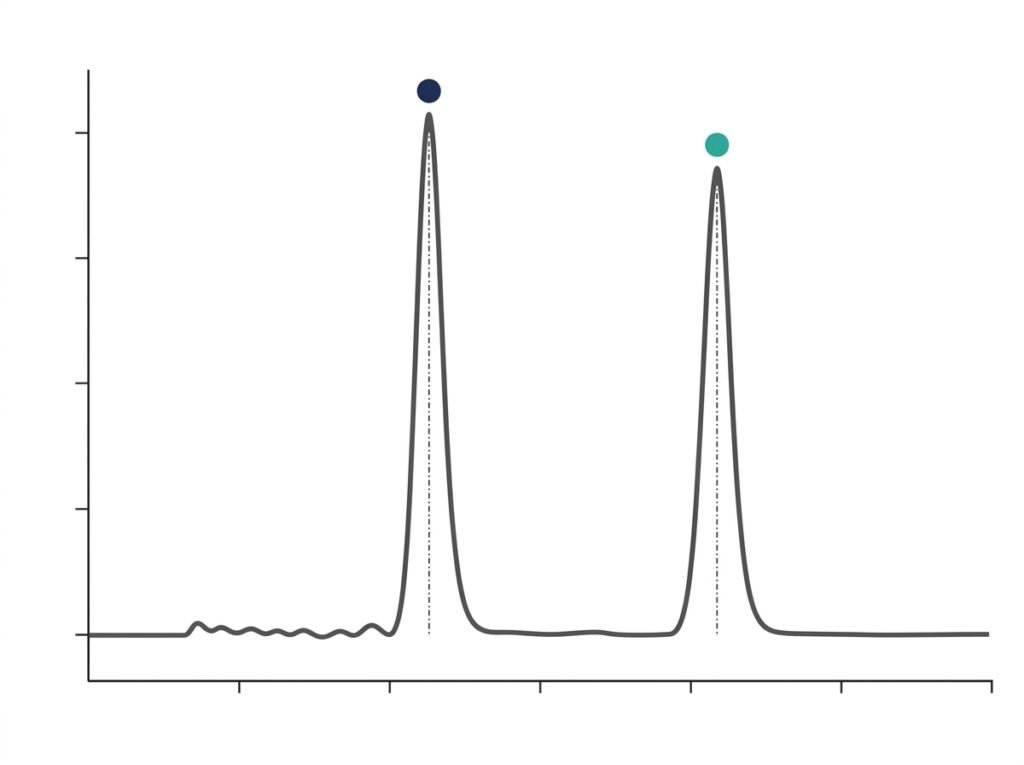
- HPLC chromatogram with two clearly resolved main peaks, one for each peptide
- Mass spectrometry results showing the observed mass for each component against its theoretical mass
- Stated quantity of each peptide per vial, such as milligrams of each, and the intended ratio
- Test date and storage recommendations
Mass spectrometry matters most for a Wolverine Blend. BPC-157 has a molecular weight of roughly 1,419 daltons, while full-length thymosin beta-4 is around 4,963 daltons, so the two should appear as clearly different masses. If a report shows only one mass, the lab may have confirmed only half the product.
Reading the Chromatogram of a Blend
In a Wolverine Blend HPLC trace, you expect two major peaks rather than one. This is normal. A common mistake is treating the smaller or later peak as an impurity when it is actually the second active component. This is why the report should label each peak and tie it to a mass spec result.
Check that both peaks are sharp and well separated, that the baseline is stable, and that the full run is shown rather than a cropped section. Shoulders or extra peaks near either main peak can indicate related impurities, such as truncated sequences. If the report offers no way to match each peak to a component, ask the supplier to explain, or have a colleague with analytical experience review it.
Ratio and Quantity: Where Blends Go Wrong
Because the two peptides are sold together, the ratio is part of the product. Many suppliers advertise an equal mass of each component in the vial. Whatever your supplier states, the documentation should confirm it. Weighing errors, uneven mixing before lyophilization, and incomplete transfer can all shift the ratio away from the label.
If your protocol depends on a defined ratio, treat the stated amounts as claims to verify rather than facts. A supplier committed to quality will explain how the Wolverine Blend is prepared and how quantity is confirmed.
Salt Form and Net Peptide Content
Peptides are usually supplied as salts, commonly acetate or trifluoroacetate (TFA). Salt form influences solubility and, in sensitive assays, can affect results. Net peptide content tells you how much of the vial’s mass is actual peptide as opposed to water and counter-ions. For a Wolverine Blend, the report should state the salt form and ideally the net content for each component, since “98% pure” and “98% peptide by mass” are different claims.
Storage and Handling for Research Labs
Lyophilized blends are more stable than solutions, but they still need care. Store the Wolverine Blend as the supplier directs, typically cold and protected from moisture and light. After reconstitution, limit repeated freeze-thaw cycles, since peptides of different sizes can behave differently in solution. Record the date, solvent, and storage conditions in your lab notebook. Treating handling as part of quality control makes your results easier to reproduce.
Red Flags When Buying a Wolverine Blend
Be cautious when a supplier:
- Cannot say exactly what the TB-500 component is
- Provides one purity number for the whole blend
- Shows a COA with no laboratory name or lot number
- Uses the same chromatogram for several products
- Advertises healing, recovery, or other human-use benefits
That last point matters. Health claims for unapproved compounds are unlawful in many regions, and a supplier that makes them is operating outside research channels.
Regulatory Context
Neither BPC-157 nor TB-500 is an approved medicine, and both appear on the World Anti-Doping Agency’s Prohibited List in some form. Regulators have also raised concerns about unverified peptides sold for personal use. Synex Bio Labs supplies the Wolverine Blend strictly for in-vitro and laboratory research, with clear research-use-only labeling.
Choosing a Wolverine Blend Supplier
A reliable source of a Wolverine Blend will name its testing laboratory, publish lot-specific reports, define each component, and answer technical questions in writing. At Synex Bio Labs, [describe your process, e.g., each blend lot is tested by an independent laboratory and the report is linked on the product page].
Explore research materials:
- Wolverine Blend
- TB-500
- Lab testing and COAs (replace URL)
External references: PubMed: BPC-157, PubMed: thymosin beta-4, WADA Prohibited List
All products are sold for in-vitro and laboratory research only.